

This week marked a structural inflection point in how global manufacturing enterprises architect their procurement and supply chain strategies. The primary catalyst was the joint announcement by Beroe and Kearney launching MAX, an AI-native decision engine designed to bridge the historical chasm between market intelligence and strategic execution. This development validates a fundamental shift that manufacturing Chief Financial Officers (CFOs) and Chief Procurement Officers (CPOs) have long anticipated: the traditional, static "System of Data" is no longer sufficient to protect margins in a highly volatile macroeconomic climate.
Concurrently, intensifying cross-border tariff complexities, structural resource volatility, and localized supply constraints have truncated the executive decision window. For leadership teams, the mandate has expanded beyond mere cost containment to comprehensive margin protection, supply continuity, and cross-functional alignment. To thrive, organizations must abandon the episodic, project-based sourcing cycles of the past and transition toward an operating model of continuous intelligence.
This brief analyzes why the convergence of raw market feeds and automated buyer judgment represents the new executive baseline, how leading organizations are re-engineering their decision velocity, and what specific questions boards must ask before Monday morning to insulate their corporate earnings from hidden supply chain risks.
Key Developments
1. The Launch of Beroe MAX Powered by Kearney
At the Digital Procurement World (DPW) conference in New York, procurement intelligence provider Beroe and global management consulting firm Kearney announced the launch of Beroe MAX. Built on a neurosymbolic framework that leverages agentic artificial intelligence, the platform functions as a connecting layer between disparate market data and internal execution systems.
What Happened: The joint venture combines Beroe's repository of global market intelligence — comprising over 28 million data signals — with Kearney's proprietary consulting methodologies, benchmarks, and decision frameworks. The system is designed to ingest an enterprise's live spend, contracts, and supplier base to surface contextualized recommendations automatically when market disruptions occur, such as tariff adjustments or commodity price spikes. The product's architecture was shaped in collaboration with a Strategic Advisory Council of 13 global procurement organizations representing highly complex supply chains.
Why It Matters: Historically, procurement has operated in a fragmented ecosystem where market data sits in one silo, consulting frameworks sit in a static slide deck, and transactional execution occurs in an ERP or sourcing tool. When macroeconomic variables shift suddenly, category managers must manually pull data, apply analytical frameworks, and devise a response. By attempting to automate this bridge, this announcement signals the end of the passive data subscription model and underscores the urgent market demand for automated, contextual recommendations.
Executive Implications: CFOs and CPOs must recognize that market intelligence is being re-commodified. The value is no longer in possessing data, but in the velocity with which that data is translated into a binding commercial decision.
2. Truncated Decision Windows from Escalating Cross-Border Tariff Friction
Regulatory changes and trade policy shifts across major manufacturing corridors have accelerated, introducing unexpected tariff structures that directly impact the bill-of-materials (BOM) cost layer for global manufacturing firms.
What Happened: Over the past week, trade compliance data across the US, EU, and APAC regions highlights a tightening of cross-border enforcement, forcing manufacturing executives to rapidly reassess sourcing origins for critical raw materials and components.
Why It Matters: Traditional sourcing models assume a stable regulatory backdrop for the duration of a contract cycle. When tariffs or trade restrictions are imposed with short implementation horizons, the lag time required to identify affected categories, evaluate alternative suppliers, and renegotiate contracts results in immediate margin erosion.
Executive Implications: Sourcing agility is now a primary financial metric. Corporate leadership can no longer treat tariff risk as an annual compliance review; it must be monitored as a real-time variance against product profitability.
3. Structural Cost Volatility in Direct Industrial Commodities
Direct commodity markets experienced acute localized price movements this week, driven by supply chain constraints and shifting industrial demand patterns, disrupting established baseline forecasts for category managers.
What Happened: Price volatility across base metals, chemical feeds, and energy inputs forced sudden recalibrations of indexing models for large-scale manufacturing operations.
Why It Matters: When commodity prices spike or drop sharply, static contracts with fixed indexing formulas can penalize buyers or leave money on the table. Organizations lacking real-time scenario planning capabilities fail to execute timely volume commitments or capture cost-avoidance opportunities.
Executive Implications: Inventory optimization and working capital management are directly tethered to these fluctuations. Sourcing executives need immediate visibility into how a commodity price movement cascades through the multi-tier supplier network down to the finished product level.
The Procurement Lens
The major alliance between Beroe and Kearney serves as an excellent case study for the current state of enterprise software and strategic sourcing. To look at this development through a sharp analytical lens: Beroe partnering with Kearney proves the procurement "System of Data" is officially broken.
First, congratulations are in order for both organizations. This partnership represents an important step forward for the procurement ecosystem, validating a thesis that forward-thinking executives have held for years: providing raw data feeds or static consulting frameworks in isolation is fundamentally inadequate for modern manufacturing complexities. They deserve immense respect for acknowledging this limitation and dedicating multi-year advisory resources to address the gap.
However, this partnership exposes a deeper structural flaw in the legacy paradigm. For decades, global enterprises have purchased expensive data subscriptions — the traditional "Systems of Data" — only to realize that data does not write contracts, mitigate risks, or protect margins on its own. To extract value from that data, corporations have historically been forced to hire premier management consultancies to build custom, episodic frameworks. The fact that a massive data aggregator and a premier global consulting firm had to forge a complex joint venture to build a middleware engine proves that the standalone data layer cannot survive in isolation. It requires a consultative layer to be useful.
The limitation of this approach is scalability. When an enterprise relies on an overlay that attempts to bridge disparate data and consulting methodologies, the model faces severe friction when scaling across hundreds of raw materials, including the highly fragmented long tail of spend, as well as the primary strategic commodities.
A truly comprehensive architecture requires a highly differentiated, unified approach based on four killer use cases:
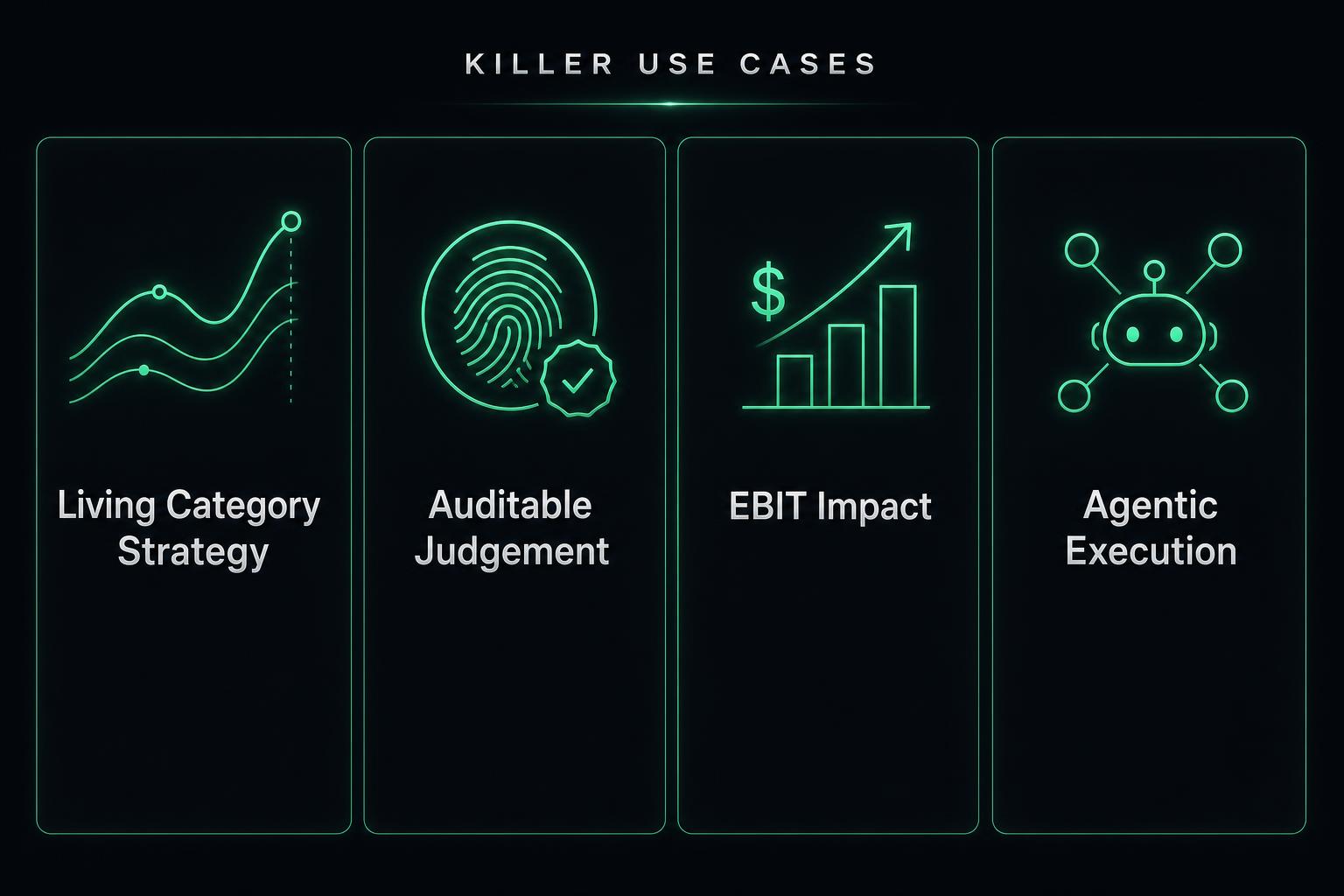
1. Living Category Strategy
A strategy must ensure that category planning stops aging. Rather than living as a static document reviewed once a year, the category strategy must remain continuously connected to live commodity prices, real-time supplier signals, looming contract cliffs, dynamic demand requirements, and granular bill-of-material (BOM) details. The required outcome is clear: when an underlying market assumption breaks, the buyer is immediately alerted; when a new market signal lands, organizational priorities re-rank automatically, and every single adaptation is versioned and preserved.
2. Auditable Judgement
A scalable decision layer must ensure that every single buy, contract adjustment, and strategic override is captured directly against the active strategy enforced at that precise moment. The specific market signals that triggered the action, the alternative options weighed, and the executive approvals must be immutably traced. This captures organizational and relationship history, allowing institutional judgment to compound over time while delivering immediate history and robust SOC-2 compliance.
3. EBIT Impact
Enterprises must possess the capability to conduct real-time impact scenario analysis at both the macro commodity level and the micro product level. This bridges the historical communication gap between the procurement function and the corporate finance team. The target outcome is to provide the CFO, CPO, and senior buyers with a comprehensive, transparent understanding of Margin at Risk at a granular product level, significantly improving executive team analysis for corporate decision-making.
4. Agentic Execution
True operational velocity requires autonomous agents capable of running the end-to-end tactical cycle. This includes shortlisting suppliers based on real-time risk profiles, drafting precise commercial offers, parsing complex multivariate supplier responses, and managing initial negotiation parameters. The business outcome is a dramatic compression of execution timelines, total alignment among internal stakeholders, and scalable decision-making across the entire spend portfolio.
The Decision Velocity Section
To achieve these outcomes, leading manufacturing organizations are fundamentally altering their internal operating models, moving away from rigid, linear processes toward a framework centered on decision velocity.
In a traditional manufacturing setup, information flows sequentially. A market disruption occurs — for instance, an unexpected environmental shutdown at a key chemical processing plant in Europe. The sequence typically unfolds as: Market Disruption → Data Provider Alert → Manual Excel Analysis → Cross-Functional Meetings → Delayed Executive Execution.
This linear progression is slow and prone to human error. By the time the category team aggregates the data, calculates the exposure across their product lines, and schedules a cross-functional alignment meeting with Finance and Operations, weeks have passed. In that intervening period, competitor organizations have locked up alternative capacity, or market prices have moved disadvantageously, resulting in direct margin erosion or factory downtime.
Leading organizations are replacing this broken sequence with an integrated operating model powered by continuous scenario planning and automated risk monitoring.
Operational Example: Consider a Tier-1 automotive component manufacturer utilizing a continuous decision velocity model. The moment a trade tariff change is announced affecting specialized steel alloys, the platform automatically parses the regulatory filing, maps the affected tariff codes directly to the company's multi-tier Bill of Materials (BOM), identifies every finished product line exposed to that specific alloy, and updates the active category strategy.
Instead of waiting for a quarterly review, information flows simultaneously across functions. The platform instantly generates three distinct mitigation scenarios:
- Absorbing the tariff cost while adjusting volume commitments with an existing domestic supplier.
- Executing a contract cliff provision to transition to a pre-qualified alternative supplier in a non-impacted region.
- Initiating an automated agentic sourcing event for the long-tail components derived from that alloy.
Because the system quantifies the exact EBIT impact and margin-at-risk exposure for each scenario, the CPO and CFO can review the options and authorize an execution strategy within hours of the regulatory shift, rather than weeks. This level of cross-functional collaboration and automation eliminates organizational drag, ensuring that supply continuity is maintained without sacrificing profitability.
The Kodiact Perspective
From an industry standpoint, world-class manufacturing organizations do not view procurement as a tactical purchasing group or an administrative back-office function. Instead, they position it as a core engine of strategic corporate finance.
The integration of market intelligence, institutional consulting frameworks, and transaction systems should not be an ad-hoc assemblage of software modules and external advisory retainers. True corporate agility is achieved through the productization of that exact relationship.
Rather than deploying middle-tier software to connect external data pools to separate advisory frameworks, the Kodiact architecture unifies raw market data feeds with continuous, automated buyer judgment directly inside a secure, enterprise-grade cloud substrate.
This model represents a philosophy rooted in several core operational principles:
- Continuous Intelligence: Shifting from episodic, project-based sourcing events to an always-on analytical posture where strategies adapt dynamically to external signals.
- Proactive Sourcing: Anticipating supplier defaults, capacity constraints, and contract risks before they manifest as supply chain failures or financial liabilities.
- Finance and Procurement Alignment: Speaking the uniform language of corporate finance. Sourcing decisions are evaluated not merely on a "purchase price variance" (PPV) metric, but on total product margin protection and return on working capital.
By hardcoding institutional knowledge and consulting logic directly into the software substrate rather than relying on manual human intervention, this approach scales seamlessly across thousands of line items. It covers both high-volume strategic commodities and volatile long-tail components with equal precision.
When an enterprise successfully productizes this capability, the financial dividends are clear and measurable: achieving a sustained 6% to 9% raw material cost improvement, significantly reducing operational risk and market disruption, compressing execution cycle times, and establishing a compounding margin advantage that competitors cannot easily replicate.
Boardroom Questions
Before Monday morning, manufacturing executives and board members should challenge their operating assumptions by addressing the following five strategic questions:
- Which raw material categories present the greatest margin-at-risk exposure today, and are those strategies being evaluated continuously or on a traditional quarterly cycle?
- How quickly can our current procurement operating model identify an unexpected cross-border tariff shift or supplier disruption before it impacts our quarterly earnings?
- What explicit percentage of our direct and indirect material spend is actively monitored via automated intelligence versus reviewed via periodic, manual spreadsheet assembly?
- Where do creeping regulatory changes, ESG exposures, and geographic supplier concentrations create hidden cost liabilities within our multi-tier bill-of-materials (BOM) layer?
- Which critical commercial and sourcing decisions are currently delayed or waiting on manual cross-functional analysis and spreadsheet reconciliation?
Conclusion
The core lesson of this week's market activity is clear: the historical separation of market data, consulting frameworks, and operational procurement execution is an artifact of a slower, less volatile industrial era. The fact that major market intelligences and consultancies are scrambling to build integrated decision engines confirms that the traditional static "System of Data" is no longer sufficient.
There should be immense humility and profound excitement regarding the rapid evolution of the enterprise procurement technology space. The broad market validation of continuous intelligence, agentic execution, and automated margin protection indicates that the entire discipline is lifting its gaze from tactical cost-cutting to true strategic leadership. For manufacturing enterprises willing to embrace this shift, abandon static paradigms, and productize continuous execution, the opportunity to secure an enduring, compounding margin advantage has never been greater.
Questions about market brief
What is the Beroe × Kearney MAX platform?
MAX is a neurosymbolic, agentic AI decision engine launched at Digital Procurement World 2026. It connects Beroe's 28 million market-data signals to Kearney's consulting frameworks and an enterprise's own live spend, contracts, and supplier base, then surfaces contextual recommendations when tariffs move, prices spike, or supply tightens. It is positioned as the connecting layer between market data, advisory methodology, and execution systems.
What is the difference between a System of Data and a System of Judgment?
A System of Data stores and serves market intelligence — prices, supplier profiles, benchmarks — and leaves interpretation to humans. A System of Judgment codifies the reasoning a senior buyer applies to that data: which signals matter for which categories, what acceptable trade-offs look like, what the next best action is. The first answers 'what is happening'; the second answers 'what should we do about it' in a way that can be audited and improved.
Why is the static data-subscription model breaking down?
Tariff regimes, regulatory deadlines, and commodity shocks now move faster than the quarterly cadence a static data feed assumes. By the time a category manager pulls the latest report, applies a framework, and routes a recommendation for approval, the spot market has already absorbed the move. Value has migrated from possessing the data to executing on it before competitors can.
What are the alternatives to Beroe and Kearney for procurement intelligence?
The category includes data providers (Expana, Vesper, Mintec), risk platforms (Resilinc, Everstream), category-management suites (Cirtuo, Per Angusta), and emerging judgment-engine players including Kodiact. The relevant question is no longer which data vendor is best; it is which platform compresses the time from signal to decision and captures buyer reasoning so it improves with each cycle.